But now you do.
Misconception: Iodine is orange in color.
Fact: Iodine in its purest form is actually violet.
Reason: The iodine they use at the doctor's right before they give you a shot or a needle is always orange. But that's because that iodine is a water-soluble form of iodine and iodine is highly reactive with water. It is also highly corrosive, especially in the presence of moisture.
Misconception: If too little iodine causes hypothyroidism then too much must cause hyperthyroidism
Fact: Too much and too little iodine actually causes too low levels of thyroid hormone.
Reason: When the levels of iodine are too high in your body, the iodine actually attacks and destroys part of the thyroid gland resulting in drop in production of thyroid hormone. (I just learned this today from my doctor)
Fact: Taking iodine pills helps your body absorb less radiation.
Misconception: Iodine has some ability to repel radioactive particles.
Fact: Radiation fallout actually contains a radioactive iodine isotope that can be absorbed and held in your thyroid for a long time causing problems.
Reason: So, why take iodine pills? By ingesting large amounts of non-radioactive amounts of iodine, your body will less likely absorb the radioactive isotope of iodine which will keep your body healthier.
Fact: Iodized salt has greatly reduced number of thyroid problems.
Fact: Iodine naturally occurs in kelp and seaweed.
Fact: Iodine deficiency is the leading cause of preventable mental retardation.
Fact: Iodine fluoresces under 514.5 nm green laser light.
This last fact is kind of important for my PhD research. The rest of it is just highly interesting.
Friday, November 4, 2011

Thursday, November 3, 2011
がんばります!
When Japan underwent its earthquake/tsunami/Fukushima power plant disaster, I first became aware of the comment, "がんばろうニッポン!" (read: ganbarou nippon!). It's like, "Good luck Japan!" but it somehow expresses more than that phrase does in English. I always think of it as the "加油" of Japanese, sufficient to encourage and support both those who are winning and those who are struggling, to express that one expects more but only because they know that you are capable of giving more in the most positive way possible.
Of course, there are variations to ganbarou such as ganbatte and ganbare. I never knew the difference between them...until now.
The other day I was watching a music video by Greeeen (yes, those 'e's are all intentional) called Love Letter. The love letter the video shows was surprisingly one that even I, with my extra-limited Japanese ability, could read and yes, even understand. "先生~ありがとう。ばんばります" (Sensei~ arigatou. Ganbarimasu) (Doctor~ Thank you. Good luck"
Aha! I figured it out!
-masu is the polite positive form of a verb in Japanese. So all those other forms are just conjugations of the verb with the root ganbaru. (Ganbaru is defined as "to stand firm, to do your best" given by the kanji 頑張 which implies a stubbornness and obstinacy in your resolve)
Ganbarou - presumptive familiar form to indicate an anticipation for something one will do. "We can do this!"
Ganbatte (kudasai) - imperative polite form to indicate a command. "Do your best!"
Ganbare - imperative familiar form to indicate a command. "You got this!"
Ganbarimasu - present indicative polite form. "Good luck!"
In any form, it's cheering.
But I have to laugh. This new understanding just makes me realize that in previous uses of this verb, I was giving commands to people I didn't know in the familiar form. Oops!
My apologies to Hasebe-san and Toshi-san.
On a side note, did you know the emoticons were used in typesetting as early as 1881?
Of course, there are variations to ganbarou such as ganbatte and ganbare. I never knew the difference between them...until now.
The other day I was watching a music video by Greeeen (yes, those 'e's are all intentional) called Love Letter. The love letter the video shows was surprisingly one that even I, with my extra-limited Japanese ability, could read and yes, even understand. "先生~ありがとう。ばんばります" (Sensei~ arigatou. Ganbarimasu) (Doctor~ Thank you. Good luck"
Aha! I figured it out!
-masu is the polite positive form of a verb in Japanese. So all those other forms are just conjugations of the verb with the root ganbaru. (Ganbaru is defined as "to stand firm, to do your best" given by the kanji 頑張 which implies a stubbornness and obstinacy in your resolve)
Ganbarou - presumptive familiar form to indicate an anticipation for something one will do. "We can do this!"
Ganbatte (kudasai) - imperative polite form to indicate a command. "Do your best!"
Ganbare - imperative familiar form to indicate a command. "You got this!"
Ganbarimasu - present indicative polite form. "Good luck!"
In any form, it's cheering.
But I have to laugh. This new understanding just makes me realize that in previous uses of this verb, I was giving commands to people I didn't know in the familiar form. Oops!
My apologies to Hasebe-san and Toshi-san.
On a side note, did you know the emoticons were used in typesetting as early as 1881?
Wednesday, November 2, 2011
Rearview
Today, by a random turn of events, I attended a meeting I had expected from which to be absent. In a hurry, I decided to parallel park on the road rather than search for a spot in the parking lot farther away.
I pulled up next to the mini-van that I would be parking behind before turning my wheel all the way over. This was really a classic textbook parallel parking job and I was confident in my abilities until I caught a glimpse in my side mirror...and then my rear-view mirror...and my side mirror again.
I was backing into a space right in front of a Jaguar! Panicking, I slammed on my brakes and started inching at a painfully slow pace towards the vehicle-I-hoped-not-to-touch. When I got as close as my nerves could bear, I turned the wheel and moved forward again. What should have been an easy and simple parking job turned into an ordeal.
When I got out to inspect my parking job, I noticed this:
I was only inches away from the mini-van in front of me.
I was a foot away from the curb.
There was a clear three foot gap between Kato and the Jag.
Scared much?
Yes.
But at least the owner of that Jag will never have to get my number and address so he can send me a bill for an imported car part worth more than me (financially speaking, of course).
I'd call it a resounding success.
And a good story.
Moral: Looking before you leap might mean you freak yourself out of doing a good job at something but at least it can prevent you from doing a really bang up BAD job at something.
I pulled up next to the mini-van that I would be parking behind before turning my wheel all the way over. This was really a classic textbook parallel parking job and I was confident in my abilities until I caught a glimpse in my side mirror...and then my rear-view mirror...and my side mirror again.
I was backing into a space right in front of a Jaguar! Panicking, I slammed on my brakes and started inching at a painfully slow pace towards the vehicle-I-hoped-not-to-touch. When I got as close as my nerves could bear, I turned the wheel and moved forward again. What should have been an easy and simple parking job turned into an ordeal.
When I got out to inspect my parking job, I noticed this:
I was only inches away from the mini-van in front of me.
I was a foot away from the curb.
There was a clear three foot gap between Kato and the Jag.
Scared much?
Yes.
But at least the owner of that Jag will never have to get my number and address so he can send me a bill for an imported car part worth more than me (financially speaking, of course).
I'd call it a resounding success.
And a good story.
Moral: Looking before you leap might mean you freak yourself out of doing a good job at something but at least it can prevent you from doing a really bang up BAD job at something.
Tuesday, November 1, 2011
Grateful
Today, in my English class, we discussed the uses of logos, ethos and pathos in rhetoric.
It was a lot of fun. I can't claim that I am the best at rhetoric; I failed at persuasive essays in English class. However, we enjoyed examining the way we communicate with people and which of the persuasive strategies we use given certain situations.
For my example of a use of rhetoric that exemplifies good use of all three strategies, I pulled out Martin Luther King Jr's I Have a Dream speech. As a class, we went through a few important points, outlining which strategy he used at various points. And then, because I didn't want my class to miss out on hearing it given, I played a recording of it.
I sat down next to my students and listened along, at first absorbed in identifying what made his speech effective.

And then I thought about what he actually meant when he used ethos to refer to the Constitution, Abraham Lincoln and the Emancipation Proclamation. I thought about that fact that 100 years after the Emancipation Proclamation, he was still arguing for and crying for his people - and all people, really - to be free.
I thought about the first time I heard this speech given. I was in second grade. We were supposed to write out all our dreams. I remember taking that assignment very seriously. For some reason, around that same time, I remember distinctly running errands with my dad (I used to beg him to always take me using this fabulous bit of child logic, "If you have to run 'erins', shouldn't you take Erin too?") He was listening to NPR and the news talked about Mikhail Gorbachev of the Soviet Union. There I was, a little girl, quite cheerfully naive of the USSR and the Cold War, listening to the radio broadcast and declare very serious subjects about the state of the world and its people. It was a jolt into the rest of the world outside of South Jacksonville and my family. I asked my dad lots of questions then. I think that might have been my first glimpse into just how big and sometimes broken this world can sometimes seem. By the time I turned in the assignment, I had written down as many little "world peace" and "goodwill and freedom to all" comments my little brain could think of.
But I didn't realize then that those dreams could be a reality. When my words were published in the local newspaper - I lived in a small village so getting the paper was really no big deal - someone handed me a copy of my assignment with a smile. On it, she wrote, "I hope your dreams come true." I just stared at those words, wondering if I really, really believed what I had written.
Martin Luther King, Jr., however, did not wonder if it could be a reality. He knew it could. He lived for that dream; he died for that dream.
I marvel that this world created a Martin Luther King, Jr. with his vision. I marvel that the world creates so many other good men and women who dream that we can yet make this place better than it is.
Back to class: Carried away by all of these thoughts by the end of that speech, I was almost in tears. One of my students started clapping proudly while the other students soon followed suit, while I just watched them in amazement. Somehow, they, too, got a glimpse of what he saw and hoped for.
I am grateful, truly grateful.
In another display of the beauty of the human spirit, I can't seem to stop listening to this amazing song by Monkey Majik with images from the tsunami that hit the Miyagi Prefecture in early March.
It was a lot of fun. I can't claim that I am the best at rhetoric; I failed at persuasive essays in English class. However, we enjoyed examining the way we communicate with people and which of the persuasive strategies we use given certain situations.
For my example of a use of rhetoric that exemplifies good use of all three strategies, I pulled out Martin Luther King Jr's I Have a Dream speech. As a class, we went through a few important points, outlining which strategy he used at various points. And then, because I didn't want my class to miss out on hearing it given, I played a recording of it.
I sat down next to my students and listened along, at first absorbed in identifying what made his speech effective.
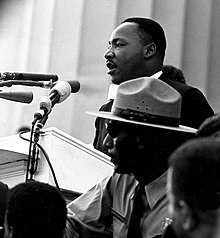
And then I thought about what he actually meant when he used ethos to refer to the Constitution, Abraham Lincoln and the Emancipation Proclamation. I thought about that fact that 100 years after the Emancipation Proclamation, he was still arguing for and crying for his people - and all people, really - to be free.
I thought about the first time I heard this speech given. I was in second grade. We were supposed to write out all our dreams. I remember taking that assignment very seriously. For some reason, around that same time, I remember distinctly running errands with my dad (I used to beg him to always take me using this fabulous bit of child logic, "If you have to run 'erins', shouldn't you take Erin too?") He was listening to NPR and the news talked about Mikhail Gorbachev of the Soviet Union. There I was, a little girl, quite cheerfully naive of the USSR and the Cold War, listening to the radio broadcast and declare very serious subjects about the state of the world and its people. It was a jolt into the rest of the world outside of South Jacksonville and my family. I asked my dad lots of questions then. I think that might have been my first glimpse into just how big and sometimes broken this world can sometimes seem. By the time I turned in the assignment, I had written down as many little "world peace" and "goodwill and freedom to all" comments my little brain could think of.
But I didn't realize then that those dreams could be a reality. When my words were published in the local newspaper - I lived in a small village so getting the paper was really no big deal - someone handed me a copy of my assignment with a smile. On it, she wrote, "I hope your dreams come true." I just stared at those words, wondering if I really, really believed what I had written.
Martin Luther King, Jr., however, did not wonder if it could be a reality. He knew it could. He lived for that dream; he died for that dream.
I marvel that this world created a Martin Luther King, Jr. with his vision. I marvel that the world creates so many other good men and women who dream that we can yet make this place better than it is.
Back to class: Carried away by all of these thoughts by the end of that speech, I was almost in tears. One of my students started clapping proudly while the other students soon followed suit, while I just watched them in amazement. Somehow, they, too, got a glimpse of what he saw and hoped for.
I am grateful, truly grateful.
In another display of the beauty of the human spirit, I can't seem to stop listening to this amazing song by Monkey Majik with images from the tsunami that hit the Miyagi Prefecture in early March.
Saturday, October 29, 2011
Saturday
Dear NSF,
Your search engine makes me smile: Whenever I type in the acronym for one of your programs (EAPSI) you always ask, "Did you mean 'pepsi'?" How is 'pepsi' somehow more relevant? How much were you paid to endorse this product? I'm very curious.
Love,
Me
Dear Mother Nature,
It was like a 30 second preview - "Winter! It's coming!" Next time, more snow, less slush. Otherwise, loved it!
Love,
Me
Dear Wolves,
You tried so hard. I could feel your strong effort all the way over here in America, despite the two minute lag on the ticker and the live German broadcast. Mandzukic was left utterly confused. Me too. We had better possession and more shots on goal. I still believe in you.
Love,
Me
Dear Yoshida-san,
You're a dear and a doll. Can we be friends? No, seriously. No? Seriously?
Love,
Me
Dear UK,
You get to set your clocks back an hour tonight. The problem with living a global community is that sometimes you think that such things apply to you too. I was excited for a few minutes before I got set straight. Only 1 week to go and counting...
Love,
Me
Your search engine makes me smile: Whenever I type in the acronym for one of your programs (EAPSI) you always ask, "Did you mean 'pepsi'?" How is 'pepsi' somehow more relevant? How much were you paid to endorse this product? I'm very curious.
Love,
Me
Dear Mother Nature,
It was like a 30 second preview - "Winter! It's coming!" Next time, more snow, less slush. Otherwise, loved it!
Love,
Me
Dear Wolves,
You tried so hard. I could feel your strong effort all the way over here in America, despite the two minute lag on the ticker and the live German broadcast. Mandzukic was left utterly confused. Me too. We had better possession and more shots on goal. I still believe in you.
Love,
Me
Dear Yoshida-san,
You're a dear and a doll. Can we be friends? No, seriously. No? Seriously?
Love,
Me
Dear UK,
You get to set your clocks back an hour tonight. The problem with living a global community is that sometimes you think that such things apply to you too. I was excited for a few minutes before I got set straight. Only 1 week to go and counting...
Love,
Me
Friday, October 28, 2011
Tidying Up
Every so often our lab has one big all hands on-deck clean-up. Today was such a day.
Each time I tackle a part of the lab that probably hasn't been touched in about 20 years. It always ends in finding some very interesting items that I never quite know what to do with. Today I found an electric pencil engraver (say what?), a mat cutter without a blade, and this...
 For those curious, the package contained some screws. I'm sure they were very special screws to be from one or more of those countries.
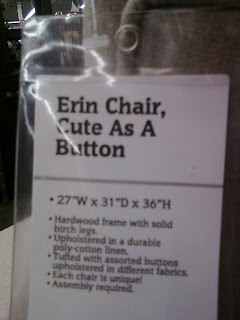
Also, the other day, I went and got my car inspected. While I waited, I went to World Market and designed my house. Actually, I didn't design my house. I only found two pieces of furniture that I wanted to own. One of them is this adorable chair. It just had my name on it.
 No, it really did.
 The other was a cute little table that opened up into a vanity. It's going in my spare bedroom. It could go in the master bedroom too. I'm just not sure if it would match the futon's frame. I think it would. I would have to check.
 And, no, I don't actually have a spare bedroom. Or a master bedroom for that matter. Or a futon. I really don't have much. But it was fun to pretend.
I also chose a really cute set of china made in Japan. They were cherry blossoms on a blue background.
 And I was talked out of some fabric dining room chairs. Upkeep of cloth with those kids I hope to have in the future is just so difficult. But they were fabulous chairs. Bright yellow!

The End.
Each time I tackle a part of the lab that probably hasn't been touched in about 20 years. It always ends in finding some very interesting items that I never quite know what to do with. Today I found an electric pencil engraver (say what?), a mat cutter without a blade, and this...

Also, the other day, I went and got my car inspected. While I waited, I went to World Market and designed my house. Actually, I didn't design my house. I only found two pieces of furniture that I wanted to own. One of them is this adorable chair. It just had my name on it.


I also chose a really cute set of china made in Japan. They were cherry blossoms on a blue background.


The End.
Thursday, October 27, 2011
質問
If you were to meet <insert famous person's name here>, what would you ask him/her?
But how can you express or get a glimpse of a person in a few moments? Do famous people themselves ever feel misrepresented and misunderstood? Do they ever scream that they want a person who sees them for themselves and not just as a tool to impress others at social events? (You know, my friend the...)
Even those of us who aren't famous, don't we also sometimes feel misrepresented and misunderstood? Can't people see beyond my exterior to find that I am a person with dreams and hopes and aspirations that cannot be grasped with mere formalities and polite conversation?
What questions can we ask to find the heart of a person? Or is that something that words cannot reach?
Listening to this on repeat. Seriously, amazing.
This situation has confronted me at multiple times in my life: posing questions to the President of the United States, posing questions to the President (and other General Authorities) of The Church of Jesus Christ of Latter-day Saints, posing questions to the President of Brigham Young University, posing questions to the newest President of The University of Virginia, posing questions to big famous guys at NASA, posing questions to Makoto Hasebe.
 |
| "Beer?" "Of course not :)" Makoto, today, at his facebook chat |
Okay, so the Makoto Hasebe one never really happened; I only found out that he was answering questions on facebook after he already finished. But the rest of the above situations really occurred.
I'm not good with important people. I get tongue-tied and my mind goes blank.
Exhibit A: Meeting L. Tom Perry: He's one of the nicest men in the world and he came to a meeting at which I participated in the choir. After the meeting, he came over to personally shake all the choir member's hands. It was exciting. After the meeting, I ran into a friend I hadn't seen in a while and stopped to chat with her. She was standing in a line waiting to get the chance to shake Perry's hand and as we chatted the line gradually moved closer and closer until my friend was suddenly shaking his hand. He turned to me to shake my hand and I blushed, "Oh! But I already shook your hand!" It wasn't meant to be, "I only shake famous people's hands once." It was really meant to be, "Your hand will get tired from shaking so many hands. I will give you a break." But alas, I'm VA (verbally awkward) so it came off poorly.
My friends have never stopped laughing about that encounter.
I could include many, many more such examples, all of them verbally awkward and not impressive.
The first time that Homer Hickam met John F. Kennedy, it had the makings of a potentially awkward encounter. The glamorous Kennedy in wild and backwoods West Virginia coming face to face with a kid about to win the National Science Fair sporting a bright orange suit. But what could potentially have become a comedy act turned into a real conversation when Hickam asked Kennedy his thoughts on outer space. (Meanwhile, my own meeting with Homer Hickam does belong in a comedy act - the irony of it all still makes me laugh)
In some way, I think, I want my meetings with people to be meaningful. An autograph, a picture, maybe a question or a comment. That's all you get. I don't like autographs. What would I ever do with it once I got it? Pictures are so impersonal. (I once got my picture taken next to an Indy 500 pace car. It was as special as the 500 people who went before me.) And you still don't know what to do with it. Somehow it seems the tokens we get from such encounters merely work as bragging stories for those who we really associate with. But I want something more: an encounter where somehow people truly meet and see, person-to-person.
But how can you express or get a glimpse of a person in a few moments? Do famous people themselves ever feel misrepresented and misunderstood? Do they ever scream that they want a person who sees them for themselves and not just as a tool to impress others at social events? (You know, my friend the...)
Even those of us who aren't famous, don't we also sometimes feel misrepresented and misunderstood? Can't people see beyond my exterior to find that I am a person with dreams and hopes and aspirations that cannot be grasped with mere formalities and polite conversation?
What questions can we ask to find the heart of a person? Or is that something that words cannot reach?
Listening to this on repeat. Seriously, amazing.
Subscribe to:
Posts (Atom)